
The low corner behind our packing shed used to hold a puddle for two days after every summer thunderstorm. My first fix was a row of lavender, because it looked great in the nursery pots.
By August, every one had rotted at the crown. (Scout dug up the last two, which saved me a job.)
That corner taught me what rain garden plants actually have to survive. After a storm, the basin sits under water for a day or two. Then a dry spell bakes it hard for weeks.
The plants below handle both. Each one comes with its moisture zone, sun needs, USDA zones, and how I care for it, and the list ends with five plants I keep out of a rain garden.
What Makes a Good Rain Garden Plant?
A rain garden plant needs three things. Missing any one is how I lost that lavender.
Temporary flooding tolerance: A working rain garden drains within 24 to 48 hours of a storm, according to University of Maryland Extension, so basin plants need roots that survive a day or two under water.
Drought tolerance between rains: The soil can then stay dry for weeks in July and August.
Deep root systems: Deep roots open channels in the soil so water soaks in faster.
I stick with natives for most of my basin, and once settled, mine get no fertilizer at all.
It helps to split a rain garden (the shallow, planted basin I walk through in how a rain garden works) into three moisture zones:
Zone 1 (center, lowest point): holds water longest, so it gets the most flood-tolerant plants.
Zone 2 (middle slopes): wet after storms and dry between them.
Zone 3 (outer edges and berm): stays mostly dry.
15 Best Rain Garden Plants by Type
Rain Garden Perennials
Perennials come back every year with deeper roots, so they make up most of my planting.
1. Blue Flag Iris (Iris versicolor)

Blue flag iris is my first pick for the basin floor. It blooms lavender-blue in late spring, and its rhizomes (thick roots that creep just under the surface) hold the basin soil in place.
Grows in: moisture zone 1, full sun to partial shade
Size and hardiness: 2 to 3 feet tall, USDA zones 3 to 9
Care: Plant rhizomes just below the soil surface. Divide clumps every 3 to 4 years.
One important caution: if the label says Iris pseudacorus, that’s yellow flag iris. Leave it on the bench.
2. Cardinal Flower (Lobelia cardinalis)

Cardinal flower, hummingbird bait from July on.
Cardinal flower produces tall spikes of intense red from midsummer into fall. The narrow, tube-shaped flowers are built for hummingbirds, and it’s one of my favorite plants for soggy corners outside the rain garden too. Great blue lobelia (Lobelia siphilitica), its blue cousin, likes the same spot.
Grows in: moisture zones 1 to 2, full sun to partial shade
Size and hardiness: 2 to 4 feet tall, USDA zones 2 to 9
Care: Each plant lives about 2 to 3 years but reseeds freely. Keep mulch off the low winter leaves so the crown doesn’t rot.
3. Swamp Milkweed (Asclepias incarnata)

Flip a few leaves and look for monarch caterpillars.
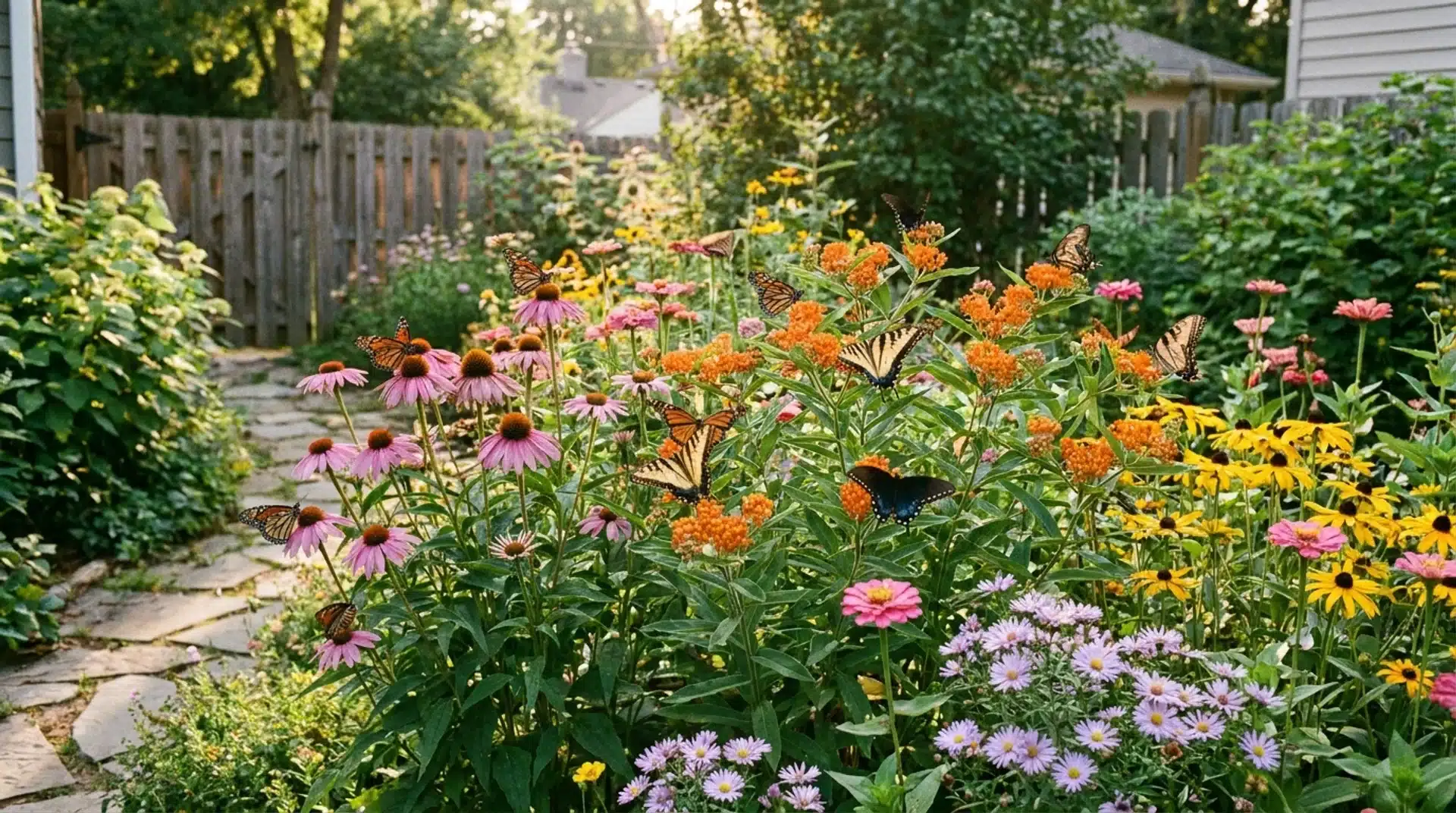
Swamp milkweed is a monarch butterfly host plant. Pink flower clusters open through summer.
It handles wet feet far better than butterfly weed (Asclepias tuberosa), so it’s the milkweed I plant for monarchs.
Grows in: moisture zones 1 to 2, full sun (blooms less in partial shade)
Size and hardiness: 3 to 4 feet tall, USDA zones 3 to 9 according to Clemson Extension
Care: Cut it to the ground in late fall. Divide every 3 to 4 years in spring.
4. Rose Mallow (Hibiscus moscheutos)

Rose mallow, also sold as hardy hibiscus, has the biggest flowers in my rain garden. White, pink, or red blooms 6 inches or more across open from July into September. It grows wild in marshes across the eastern US, so a flooded basin floor doesn’t bother it.
It’s also the last plant up each spring. Mine don’t send up new shoots until late May, so I mark the spot before I mulch.
Grows in: moisture zones 1 to 2, full sun (fewer flowers in partial shade)
Size and hardiness: 3 to 7 feet tall, USDA zones 5 to 9
Care: Cut the dead stems to about 4 inches in late fall or early spring. Check the leaves for hibiscus sawfly larvae in early summer.
5. Joe-Pye Weed (Eutrochium maculatum)

Joe-pye weed towers over everything by late August.
Joe-pye weed is a tall back-of-garden plant that blooms in late summer. The domed purple flower heads pull in monarchs, swallowtails, and native bees. It tops my list of flowers that attract butterflies.
Grows in: moisture zones 1 to 2, full sun to light shade
Size and hardiness: 4 to 7 feet tall, USDA zones 4 to 8
Care: Pinch the tips in early June so it skips the staking. Cut it back in late fall.
6. Bee Balm (Monarda didyma)

Bee balm has shaggy red, pink, or purple flowers in early to midsummer, and hummingbirds work it as hard as the bees do. It likes evenly moist soil, which makes the middle slopes a good fit.
In our hot North Carolina summers, I give it a spot with afternoon shade.
Grows in: moisture zone 2, full sun to partial shade
Size and hardiness: 2 to 4 feet tall, USDA zones 4 to 9
Care: Pick mildew-resistant cultivars and leave room for airflow. Divide every 2 to 3 years so it doesn’t crowd its neighbors.
7. Purple Coneflower (Echinacea purpurea)

Every seed head stays put until spring.
Purple coneflower works in the transitional and outer zones of the garden. Once established, it rides out brief flooding and dry spells.
I don’t deadhead mine. The seed heads feed goldfinches all winter, and a few always reseed into the gaps.
Grows in: moisture zones 2 to 3, full sun (blooms less in partial shade)
Size and hardiness: 2 to 4 feet tall, USDA zones 3 to 9
Care: Leave the seed heads standing. Divide every 4 years if crowded.
8. New England Aster (Symphyotrichum novae-angliae)

Still feeding bees after everything else quits.
New England aster is one of the last native perennials to bloom each year, providing nectar into October when most other plants have finished. Migrating monarchs and native bees depend on that late food.
Grows in: moisture zones 2 to 3, full sun (tolerates light shade)
Size and hardiness: 3 to 6 feet tall, USDA zones 4 to 8
Care: I buy mildew-resistant cultivars, since it gets powdery mildew in humid spots.
9. Turtlehead (Chelone glabra or C. lyonii)

Look closely and the name makes sense.
Turtlehead is one of the best rain garden perennials for partial shade. Its pink or white flowers open in late summer and early fall, when few shade plants bloom. It also hosts the Baltimore checkerspot butterfly.
It’s slow to settle in, so don’t judge it in year one.
Grows in: moisture zones 1 to 2, partial shade to full sun
Size and hardiness: 2 to 4 feet tall, USDA zones 3 to 8
Care: Keep the soil moist all season and leave the roots alone.
Rain Garden Grasses and Sedges
Grasses and sedges do some of the hardest work in a rain garden. Their dense, fibrous roots keep the soil open year after year and hold their shape through winter.
10. Switchgrass (Panicum virgatum)

Switchgrass catching the October light.
Switchgrass is the most adaptable native grass on this list. It handles wet soil, dry soil, clay, and sand. Airy seed heads glow in fall light, and cultivars range from 2 to 6 feet tall.
Grows in: moisture zones 2 to 3, full sun (tolerates light shade)
Size and hardiness: 3 to 6 feet tall by cultivar, USDA zones 5 to 9
Care: I leave it standing for the birds, then cut it back in late winter.
11. Little Bluestem (Schizachyrium scoparium)

Rusty orange from November on.
Little bluestem turns red-orange in fall and holds that color all winter. It’s my pick for the dry outer edge, and it shrugs off drought once established.
Grows in: moisture zone 3, full sun
Size and hardiness: 2 to 3 feet tall, USDA zones 3 to 9
Care: Cut it to about 4 inches in late winter. Skip fertilizer, since extra nitrogen makes the stems flop.
12. Soft Rush (Juncus effusus)

Soft rush, right where the water comes in.
Soft rush isn’t showy. It earns its spot at the inflow, where erosion is worst, and it tolerates standing water longer than almost anything else here.
Grows in: moisture zone 1, full sun to partial shade
Size and hardiness: 2 to 4 feet tall, USDA zones 4 to 9
Care: Divide when clumps get very dense.
Rain Garden Shrubs
Shrubs anchor the garden and grow the deepest roots in the bed. Without one, a rain garden looks flat by December, and even a small rain garden has room for one.
13. Red-Twig Dogwood (Cornus sericea)

Red stems on a gray winter day. That’s the whole point.
Red-twig dogwood has white flowers in spring, blue-white berries for the birds in fall, and bright red bare stems all winter. It tolerates wet soil better than most common shrubs.
Here in North Carolina, I’m choosy about it. It prefers cool summers, and USDA zone 7 is about its southern limit, so anywhere warmer I plant buttonbush instead.
Grows in: moisture zones 2 to 3, full sun to partial shade
Size and hardiness: 6 to 8 feet tall, USDA zones 2 to 7
Care: Each spring, cut a third of the oldest stems to the ground for brighter new ones.
14. Buttonbush (Cephalanthus occidentalis)

The bees find these within a day.
Buttonbush has round white flower heads in midsummer and is one of the few native shrubs that can live on the basin floor. It suits larger rain gardens.
Grows in: moisture zones 1 to 2, full sun to partial shade
Size and hardiness: 5 to 12 feet tall (smaller with pruning), USDA zones 5 to 9
Care: Cut it back in late winter to control size, and pull suckers at the base.
15. Summersweet (Clethra alnifolia)

You’ll smell summersweet before you see it.
Summersweet is a fragrant shrub that handles wet soil and shade. Its bottlebrush flowers open in July and August, and it’s my go-to for a partly shaded rain garden.
Grows in: moisture zones 2 to 3, partial shade to full sun
Size and hardiness: 4 to 8 feet tall, USDA zones 4 to 9
Care: Remove dead wood in early spring. Pull suckers to keep it in bounds.
Rain Garden Plants for Shade
Shade changes two things. Most flowering natives need 6 or more hours of sun to bloom well, and shaded basins dry out more slowly, which raises the risk of root rot on the basin floor.

Turtlehead and Pennsylvania sedge are my most dependable shade picks. These also do well in lower light:
Plant Type | Plant | Key Details |
|---|---|---|
Perennial | Wild Columbine (Aquilegia canadensis) | Red and yellow spring flowers; 1–3 feet; Zones 3–8; self-seeds |
Perennial | Jacob’s Ladder (Polemonium reptans) | Blue spring flowers; 8–12 inches tall; Zones 3–8; good for shaded outer edges (moisture zone 3) |
Sedge | Pennsylvania Sedge (Carex pensylvanica) | Low ground cover for dry to average shade on the outer edge; 6–12 inches; Zones 3–8; no cutting back |
Sedge | Palm Sedge (Carex muskingumensis) | Upright grass-like foliage; grows around 2 feet; tolerates wet shade in moisture zones 1 and 2 |
Shrub | Oakleaf Hydrangea (Hydrangea quercifolia) | White flowers; peeling winter bark; 4–8 feet; Zones 5–9 |
Shrub | Virginia Sweetspire (Itea virginica) | Fragrant white flower spikes in late spring; red fall color; 3–5 feet; Zones 5–9; handles wet soil and part shade |
Shrub | Winterberry (Ilex verticillata) | Red winter berries; 6–10 feet; Zones 3–9; needs a male plant for fruit |
Rain Garden Plants to Avoid

Pretty in the pot, trouble in the basin.
A few plants sold at US nurseries cause trouble in a rain garden, either because they’re invasive or because they can’t handle the wet and dry cycle.
Yellow Flag Iris (Iris pseudacorus): It’s invasive in many states, where it spreads along waterways and crowds out natives. Check the botanical name every time.
Purple Loosestrife (Lythrum salicaria): It’s sometimes sold as an ornamental, but it’s an invasive wetland weed that seeds heavily and overruns native wetlands.
Japanese Knotweed (Fallopia japonica): It grows happily in damp ground, but it’s an aggressive invader that is very hard to remove once it’s in.
Annual Plants as Core Planting: Their shallow roots don’t help drainage, and replanting every year disturbs the soil. I only tuck a few in during the first season.
True Wetland and Bog Plants: Plants sold for ponds and bogs need soil that never dries, so they fail once the basin dries out.
How to Plant and Space Rain Garden Plants
Groups of three to five, spaced to touch in two years.
The basin depth and layout need to be right before anything goes in, since the moisture zones follow its shape.
Plant in Groups: I plant perennials in groups of three to five of one species. Groups fill in faster and crowd out weeds.
Follow Proper Spacing: Space plants about two-thirds of their mature width apart, roughly 12 to 18 inches for most perennials here.
Plant at the Right Depth: Set each plant at the depth it grew in the pot, with soil kept off the crowns.
Apply the Right Mulch: Spread 2 to 3 inches of shredded hardwood. It knits together, while bark nuggets float off in heavy rain.
Choose the Right Planting Time: I plant in October here in North Carolina, while the soil is still warm. In colder areas (roughly USDA zones 3 to 5), plant in spring after the last frost or by early September. Skip midsummer.
Water During the First Year: Give new plants about 1 inch of water a week in dry stretches. Slow growth in year one is normal.
If water stands longer than 48 hours, the soil is the problem (that’s when I’d look at other yard drainage fixes).
The Corner That Drowned My Lavender Feeds Monarchs Now
That low spot behind the shed now has soft rush at the inflow, swamp milkweed in the middle, and little bluestem on the edge. Last September I found monarch caterpillars on the milkweed.
A patch of ground I used to fight now feeds butterflies.
Which plants are you planning to use? Tell me in the comments.
Rain Garden Plant FAQs
Do rain garden plants have to be native?
No, but natives are the easiest choice. They’re adapted to local rain and drought and rarely need fertilizer.
Will a rain garden attract mosquitoes?
Not if it drains properly. A working rain garden empties within 24 to 48 hours, which is too fast for mosquito larvae to develop.
Are rain garden plants the same as plants for wet areas?
Not quite. Rain garden plants handle flooding and drought. Plants for wet areas expect soil that stays damp all season.
When is the best time to plant a rain garden?
Fall works best in the South, while the soil is still warm. In colder zones, spring after the last frost is the safer window.