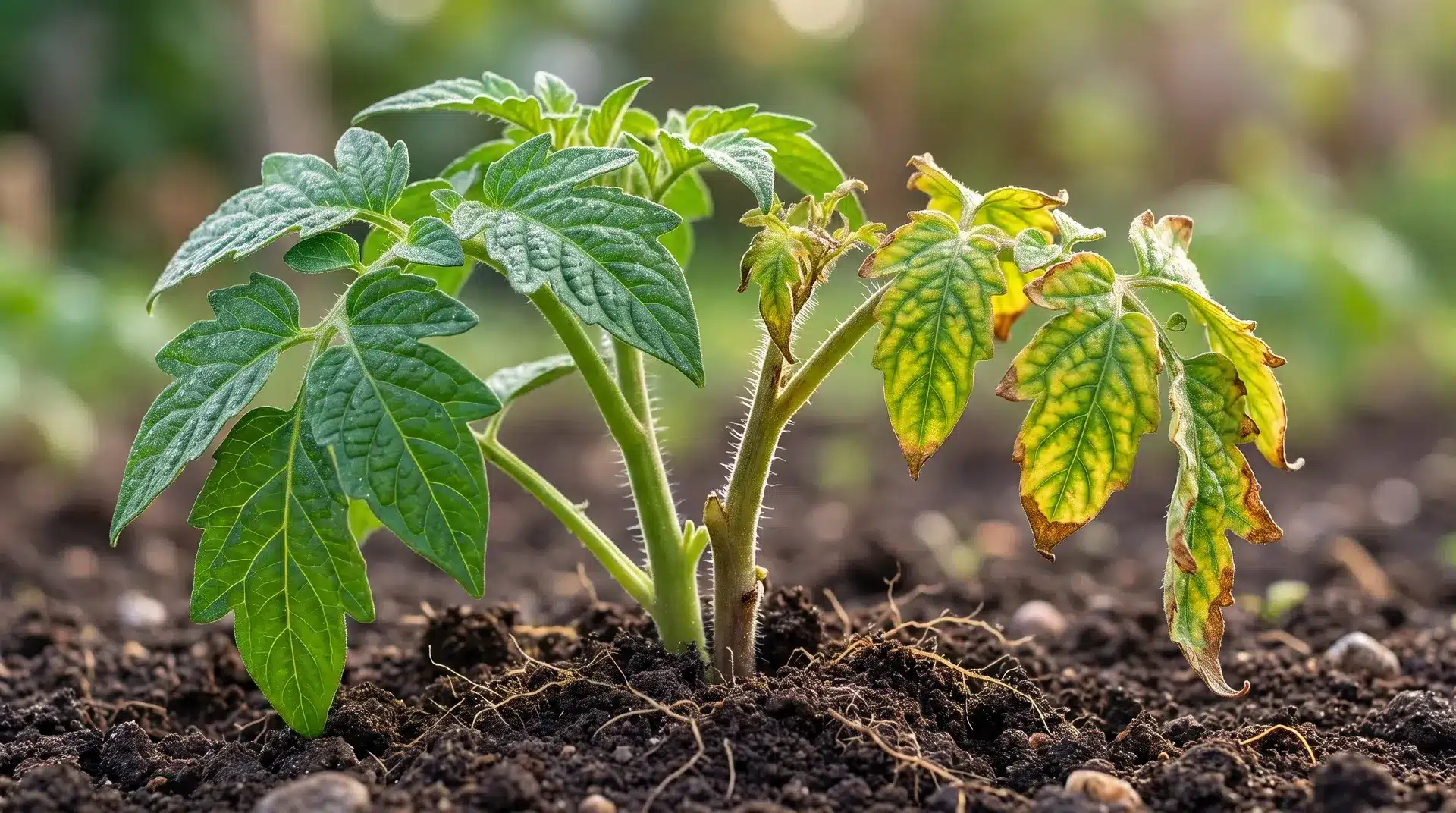
I’ve watered on schedule, checked the light, and still watched a plant’s leaves turn yellow for no obvious reason. Most of the time, the missing piece is nutrition, not care.
Nutrient deficiency in plants shows up in patterns: which leaves change first, what color they turn, how the veins look. Once you know those patterns, the diagnosis takes minutes instead of guesswork.
This guide covers what causes nutrient deficiency, how to identify which nutrient is missing, and the fastest way to fix it.
What Is Nutrient Deficiency in Plants?
Nutrient deficiency in plants happens when a plant cannot get enough of one or more elements it needs to grow. These elements fall into two groups.
Macronutrients are needed in large amounts. They include nitrogen (N), phosphorus (P), potassium (K), calcium (Ca), magnesium (Mg), and sulfur (S).
Micronutrients are needed in smaller amounts but are just as important. These include iron (Fe), manganese (Mn), zinc (Zn), boron (B), copper (Cu), molybdenum (Mo), and nickel (Ni).
I didn’t know the next part for years, and it’s the fastest shortcut to diagnosis once you do.
Mobile nutrients, such as nitrogen, phosphorus, potassium, and magnesium, can move within the plant. When a plant runs low on these, it pulls them from older leaves and sends them to new growth. So deficiency symptoms show up on the lower, older leaves first.
Immobile nutrients like calcium, iron, boron, and copper cannot move once absorbed. When the plant runs short, it cannot redirect them. So symptoms show up on new growth first.
That one detail tells you a lot before you even test your soil.
What Causes Nutrient Deficiency in Plants?
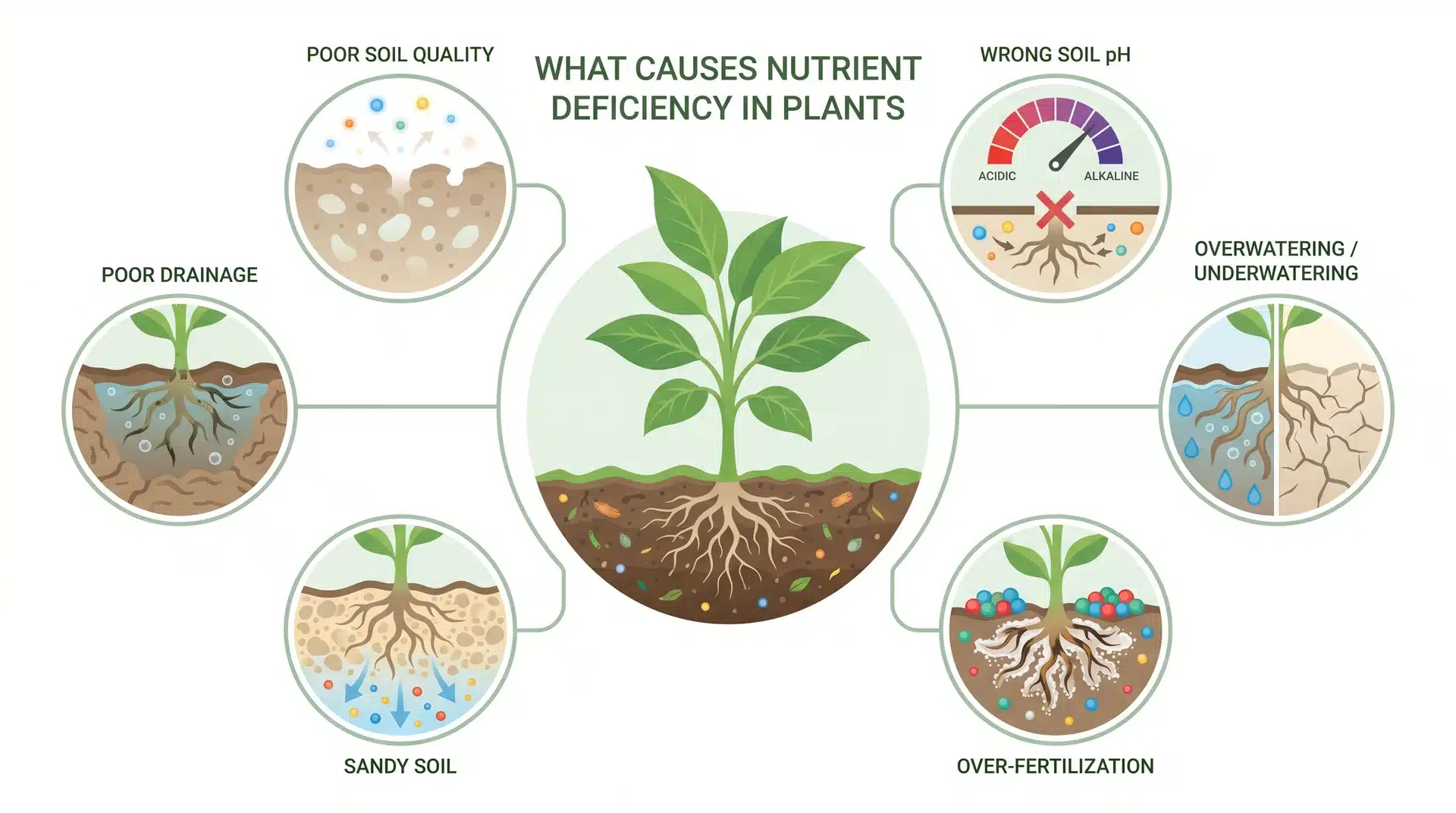
A plant can sit in nutrient-rich soil and still show deficiency symptoms. Here is why that happens.
1. Poor soil quality: Nutrients get used up over time. Soil that has been planted repeatedly without being refreshed will eventually run low.
2. Wrong soil pH: This is the most overlooked cause. Even when nutrients are physically present in the soil, the wrong pH level locks them away from the roots. Plants cannot absorb them. Most plants do best in a soil pH range of 6.0 to 7.5. I test mine every spring, and it catches more deficiencies than any fertilizer schedule I’ve tried.
3. Overwatering or underwatering: Both limit root function. Roots that sit in waterlogged soil or dry out too much lose their ability to pull nutrients from the soil. Getting your watering schedule consistent solves this before any fertilizer does.
4. Over-fertilization: Too much fertilizer causes salt buildup in the soil. This blocks the roots from taking up key elements, a problem called nutrient lockout.
5. Sandy or fast-draining soil: Sandy soils lose nutrients quickly because water carries them away before roots can absorb them.
6. Poor drainage: Soggy soil damages roots at the cellular level, cutting off the plant’s main path for nutrient uptake.
Common Nutrient Deficiencies in Plants and Their Symptoms
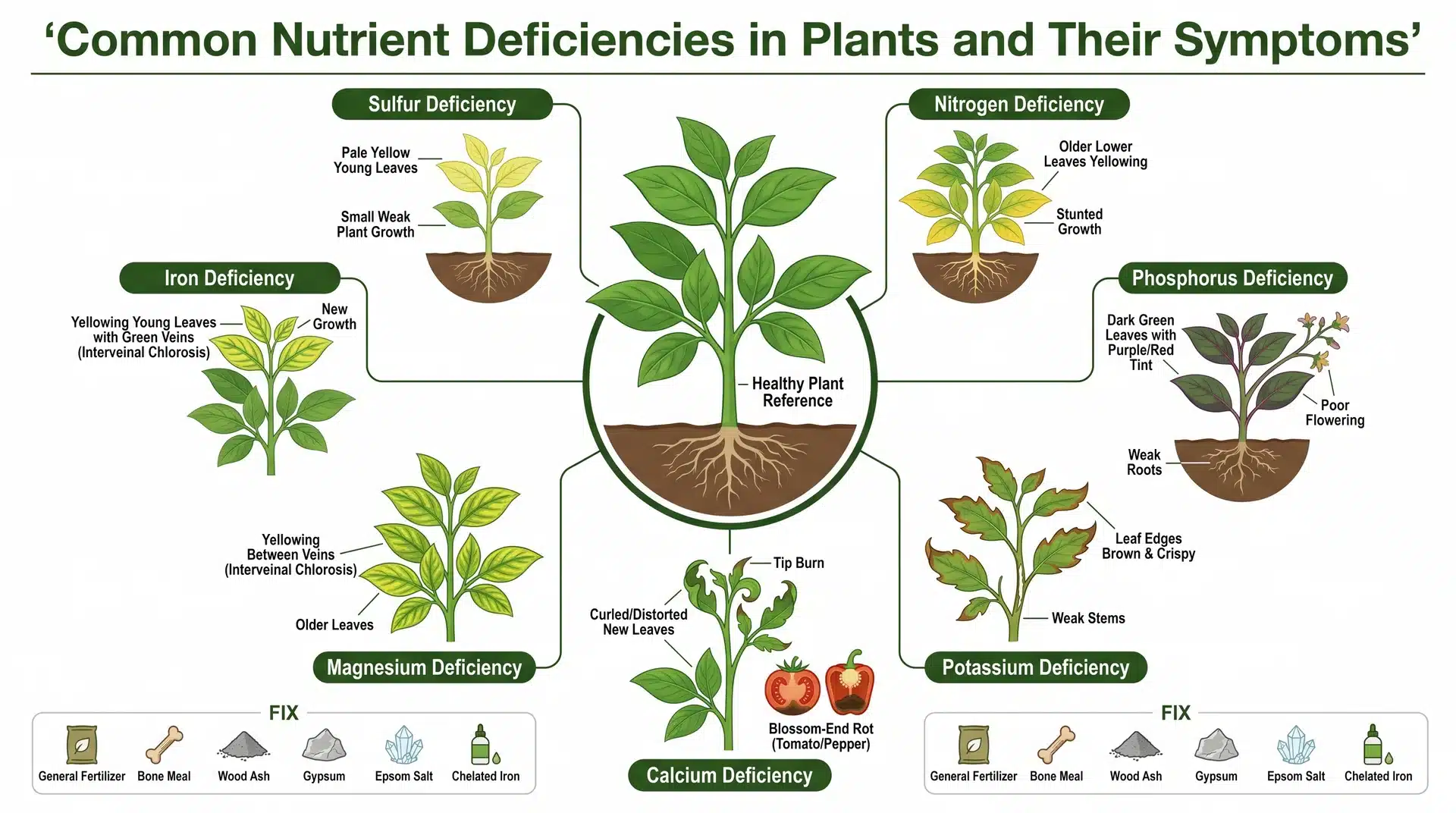
Plants cannot tell you what they need, but their leaves can. Here is what to look for with each nutrient.
1. Nitrogen Deficiency
Nitrogen is a building block of chlorophyll. It keeps leaves green and supports stem and leaf growth.
Signs: Yellowing that starts on the older, lower leaves and works its way up. Growth slows down noticeably.
Fix: Apply a nitrogen-rich fertilizer. Alfalfa meal or cottonseed meal works well as an organic option. I use rice water as a mild supplemental feed between regular fertilizing, and I also work coffee grounds as fertilizer into the topsoil for a slower dose.
2. Phosphorus Deficiency
Phosphorus supports root development, energy transfer, and flower and seed production.
Signs: Leaves turn purple or reddish, especially on the undersides. Roots stay small. Flowering and fruiting are poor.
Fix: Add a phosphorus fertilizer or bone meal. Check that soil pH is not too high, as alkaline soil binds phosphorus with calcium.
3. Potassium Deficiency
Potassium helps regulate water movement in the plant and keeps cell walls strong.
Signs: Leaf edges and tips turn brown and crispy. Stems may feel weak. Older leaves show symptoms first.
Fix: Apply potassium sulfate or a balanced NPK fertilizer. Wood ash is a natural source of potassium.
4. Calcium Deficiency
Calcium strengthens cell walls and supports new tissue formation. Since it is immobile, symptoms always appear on new growth.
Signs: Distorted or curled young leaves. Tip burn on new shoots. Blossom-end rot in tomatoes and peppers.
Fix: Use calcium nitrate as a soil drench for fast correction. Dolomitic lime also works and adds magnesium at the same time.
5. Magnesium Deficiency
Magnesium sits at the center of every chlorophyll molecule. It is a mobile nutrient, so symptoms show on older leaves first.
Signs: Yellow patches between the leaf veins while the veins themselves stay green. This pattern is called interveinal chlorosis.
Fix: Epsom salt (magnesium sulfate) dissolved in water works fast. Apply as a foliar spray or a soil drench.
6. Iron Deficiency
Iron is immobile and is frequently unavailable in alkaline soils, even when it is physically present.
Signs: Interveinal yellowing on the newest, youngest leaves. The veins stay green, but the tissue between them turns pale yellow.
Fix: Use chelated iron, particularly Fe-EDDHA, in high-pH soils. Chelated forms stay soluble under alkaline conditions, while regular iron salts break down.
7. Sulfur Deficiency
Sulfur matters most during early growth stages and seed development.
Signs: Young leaves turn pale or yellow. Plants look small and underdeveloped, especially early in the season.
Fix: Apply sulfate-based fertilizers. Gypsum (calcium sulfate) is a common and affordable source.
How to Identify Nutrient Deficiency in Plants: Step-by-Step
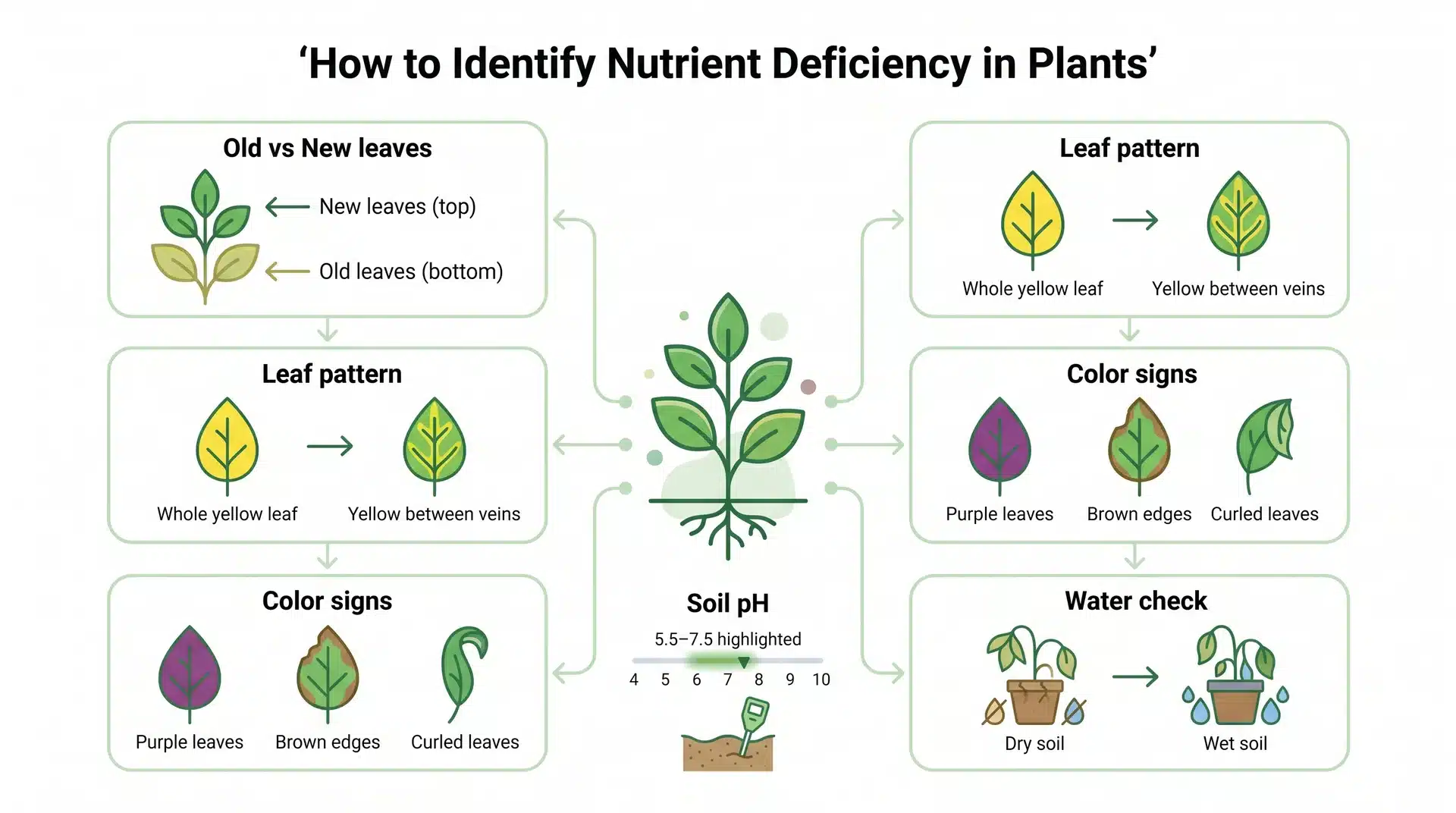
Guessing the cause and grabbing a fertilizer often makes things worse. Follow these steps instead.
Step 1: Look at which leaves are affected. Old leaves showing problems? Think mobile nutrients: nitrogen, phosphorus, potassium, or magnesium. Are new leaves affected? Think immobile nutrients: calcium, iron, boron, or copper.
Step 2: Study the leaf pattern. Is the whole leaf yellow, or is it yellow between the veins? Whole-leaf yellowing points to nitrogen. Interveinal yellowing points to magnesium on old leaves or iron on new leaves.
Step 3: Check the color more closely. Purple or red tones suggest phosphorus. Brown, crispy edges suggest potassium. Distorted, curled new growth points to calcium.
Step 4: Test your soil pH. Before spending money on fertilizer, buy a basic soil testing kit. If your pH is off, adding nutrients without fixing it is a waste. Most nutrients become unavailable above pH 7.5 or below pH 5.5.
Step 5: Check your watering habits. Roots that are waterlogged or bone-dry cannot absorb water. Correct your watering first, then reassess.
The Role of Soil pH in Nutrient Availability
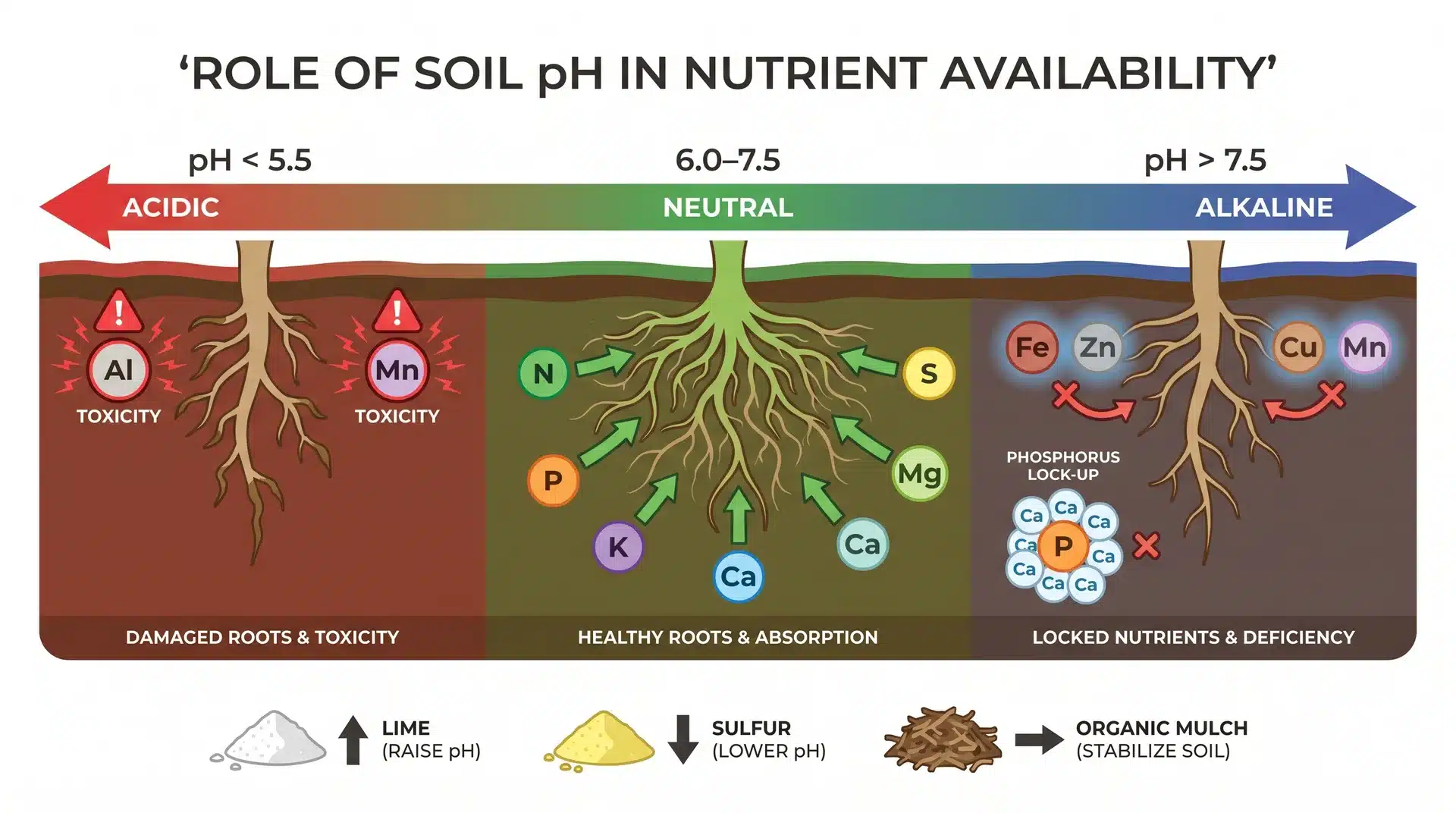
Soil pH is one of the most powerful factors in nutrient deficiency in plants.
When soil is too acidic (pH below 5.5), toxic levels of aluminum and manganese can build up, damaging roots.
When soil is too alkaline (pH above 7.5), micronutrients such as iron, zinc, copper, and manganese become less soluble. The plant cannot absorb what it cannot reach.
Phosphorus behaves differently in alkaline soil. It binds tightly with calcium, forming compounds the plant cannot use. This is why phosphorus deficiency is so common in soils that look rich on paper.
To raise soil pH, add agricultural or dolomitic lime before planting.
To lower soil pH, work elemental sulfur, iron sulfate, or organic matter into the topsoil. Organic mulch added regularly also helps keep pH stable over time.
How to Fix Nutrient Deficiency in Plants
There is no single fix that works for every situation. Match the method to the nutrient and the severity.
1. Foliar spray works best for micronutrients like iron, zinc, and manganese. It delivers nutrients directly through the leaf surface. This is the fastest method when roots cannot absorb from the soil due to pH issues.
2. Soil drenching is a better choice for mobile nutrients like nitrogen and potassium. A nutrient solution is poured directly into the soil for rapid root absorption.
3. Chelated fertilizers are the most reliable option for micronutrient deficiencies in high-pH soils. Chelates are organic molecules that wrap around metal ions like iron and zinc, keeping them soluble and available to roots even in alkaline conditions.
4. Granular or slow-release fertilizers do not correct an immediate problem, but they build up nutrient reserves over time. They are a good long-term maintenance tool, not an emergency fix.
I’ve made my own low-cost nitrogen booster with kitchen scraps, and it works if you pair it with a soil test so you know what you’re actually adding. If you want the full method, I wrote it up here: DIY plant food.
How to Prevent Nutrient Deficiency in Plants
Prevention is simpler than correction. These habits make a real difference.
- Test your soil before every growing season: A basic test shows pH and major nutrient levels. It costs very little and saves a lot of guesswork.
- Use balanced fertilizers for your plant type: Vegetables, flowering plants, and leafy greens have different needs. A one-size-fits-all fertilizer often leaves gaps.
- Add organic matter every year: Compost improves soil structure, supports beneficial microbes, and slowly releases nutrients as it breaks down.
- Water consistently: Irregular watering stresses roots and disrupts nutrient absorption. Steady, appropriate moisture matters more than any single fertilizer.
- Match your plants to your soil type: Sandy soils need more frequent feeding. Dense clay soils often need drainage improvements before nutrients can reach roots.
Once you’ve corrected a deficiency, a regular homemade fertilizer routine keeps it from coming back.
Trust What the Leaves Are Telling You
Nutrient deficiency in plants is not always obvious, but it follows patterns.
Which leaves are affected, what color they turn, whether growth is stunted or curled: each detail points to a specific cause.
Fix the soil pH first, then address the missing nutrient with the right method.
Regular soil testing and consistent watering will keep most deficiencies from showing up in the first place.
Take a close look at your plant next time it seems off. The answer is usually right there in the leaves.
Frequently Asked Questions
Can Too Much Nitrogen Hurt Plants?
Yes. Too much nitrogen causes toxicity that weakens stems and reduces flowering and fruiting, even though plants need some nitrogen to grow leaves.
Can Overwatering Cause Phosphorus Deficiency?
Even if everything else is ideal, a phosphorus deficiency can occur due to overwatering or compact, wet soil.
Do Coffee Grounds Add Nitrogen to Plants?
Yes, coffee grounds provide nitrogen, about 1% to 2%, but that nitrogen is locked up in organic molecules and releases slowly.
How Is Nutrient Deficiency Different From Overwatering Damage?
Overwatering damages roots first, so leaves wilt or yellow all over. Nutrient deficiency follows a pattern tied to specific leaves and colors.