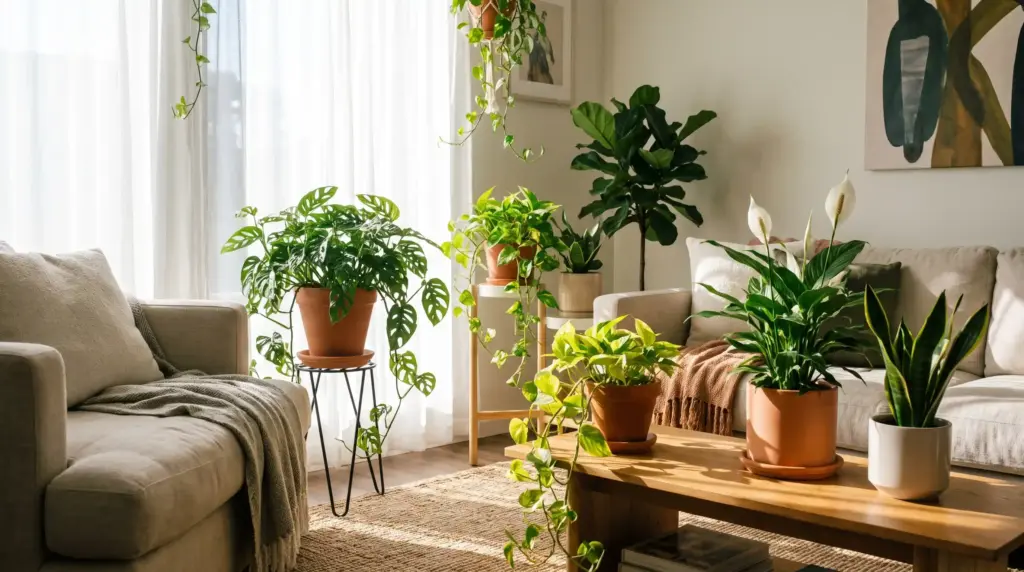
Bright indirect light means a spot where the room is genuinely bright during daylight hours, but no direct sunbeam is landing on your plant’s leaves.
Basically, bright indirect light is a bright room with no direct beam on the foliage.
For most tropical houseplants, the intensity sits between roughly 1,000 and 5,000 lux, which is about 90 to 465 foot-candles. The University of Maryland Extension notes that indoor light intensity drops sharply as you move away from a window, which is why the same room can be bright indirect light near the glass and low light a few steps back.
Direct sunlight, by comparison, runs well above 1,000 foot-candles and can climb past 10,000 in a sunny window. Bright indirect light gives a plant enough energy to grow without the heat and intensity that burn tender leaves.
What Is Indirect Sunlight?
Indirect sunlight is daylight that has been filtered, diffused, or reflected before it reaches your plant, rather than striking the leaves as a straight, unblocked beam. A cloud, a sheer curtain, a tree canopy, or a light-coloured wall all turn direct sun into indirect sunlight.
Most houseplants sold in the US are tropical plants. In the wild, they grow under a thick tree canopy, where light filters through layers of leaves before reaching them.
That filtered light is bright enough to drive photosynthesis but gentle enough not to scorch. Indirect sunlight indoors recreates that same filtered condition.
What Does Bright Indirect Light Look Like?
Bright indirect light looks like an open, well-lit room where you could comfortably read a book without turning on a lamp, but where you cannot see a hard-edged patch of sun sitting on the floor, wall, or plant.
If you can trace a crisp bright rectangle cast by the window onto a surface, that surface is in direct sun. If the whole room simply feels light and airy with no sharp sun patch on the plant, that is bright indirect light.
The easiest way to confirm it is not to eyeball the room at all. It is to check the shadow
The 30-Second Shadow Test

This is the fastest way to know what kind of light you are actually working with, and no tools are required.
Hold your hand about 12 inches above a sheet of white paper in the spot where your plant sits. Do this at midday on a clear day for the most accurate reading.
Here is what your shadow tells you:
- Sharp, dark shadow with crisp edges: Direct sunlight. Too intense for most tropical houseplants without protection.
- Soft shadow with visible but blurry edges: Bright indirect light. This is the sweet spot for the most popular indoor plants.
- Faint shadow, barely there: Medium indirect light. Many plants survive here, but growth slows.
- No shadow at all: Low light. Suitable only for very tolerant plants, such as ZZ plants or cast-iron plants.
Low light like this is common in north-facing rooms, where plants for north-facing windows tend to perform far more reliably than standard houseplant varieties.
Bright, Medium, and Low Indirect Light: The Three Tiers
Indirect light is not one setting. It is a range, and knowing which tier you have prevents most placement mistakes. Bright indirect light sits at roughly 1,000 to 5,000 lux (about 90 to 465 foot-candles) and throws the blurry-edged shadow you are aiming for; this is where most tropical houseplants thrive.
Drop to around 500 to 1,000 lux, and you are in medium indirect light, where the shadow goes faint, and plants keep growing but slowly. This is the medium to bright indirect light range you see on so many care labels. Below about 500 lux there is no visible shadow at all, and only the toughest plants hold on.
The gap between these tiers is real, not cosmetic. A plant labelled bright indirect light will often tolerate the medium tier for a while, but it grows noticeably slower and can decline over a few months, which is why so many people think their plant is sick when it is really just underlit.
Where to Find Bright Indirect Light in Your Home
Window direction matters more than we realize. Here is a quick breakdown:
| Window Direction | Midday Behavior | Best Plant Distance | Quick Note |
|---|---|---|---|
| East-facing | Gentle morning sun | 0 to 2 ft from sill | Easiest window for bright indirect light |
| South-facing | Brightest all day | 2 to 5 ft back | Use a sheer curtain or step back |
| West-facing | Strong afternoon sun | 2 to 4 ft back | Sheer optional, watch for leaf scorch |
| North-facing | No direct sun, diffused | On the sill | May not hit the BIL threshold in winter |
A north-facing window gives the gentlest, most even light of any direction, but “gentle” also means dim.
In most homes, a north window sits at the medium-to-low end rather than true bright indirect light, so it suits tolerant plants better than light-hungry ones. Positions more than about six feet from any window rarely qualify as bright indirect light either.
Real rooms change these numbers. Trees outside, roof overhangs, neighbouring buildings, and even dirty windows all cut the light coming through. If your south-facing window faces a tall hedge, treat it more like an east window.
And distance always matters: moving a plant three feet further from a window can cut its light by more than half. That is not an exaggeration; it is simply how light behaves in enclosed spaces.
How to Get Bright Indirect Light in Any Room
You can create bright indirect light in almost any home with a few adjustments. The easiest is a sheer curtain: if a south or west window throws too much direct sun, a white or off-white sheer filters it into usable bright indirect light.
Just make sure you can see through the fabric, because thick blackout curtains do the opposite of what you want.
If the room is dim rather than too bright, work with reflection instead. A white wall or a mirror placed across from a window bounces diffused light back into the space, and it makes a bigger difference than most people expect.
When neither is enough, add a full-spectrum LED grow light set 12 to 18 inches above the plant and running 12 to 16 hours a day, which reliably mimics bright indirect light.
Grow lights supplement a window beautifully, but they do not always replace a genuinely bright window for larger plants like Bird of Paradise or Fiddle Leaf Fig, so start with placement and add light only where the room falls short.
Why Your Plant’s Light Changes with the Seasons
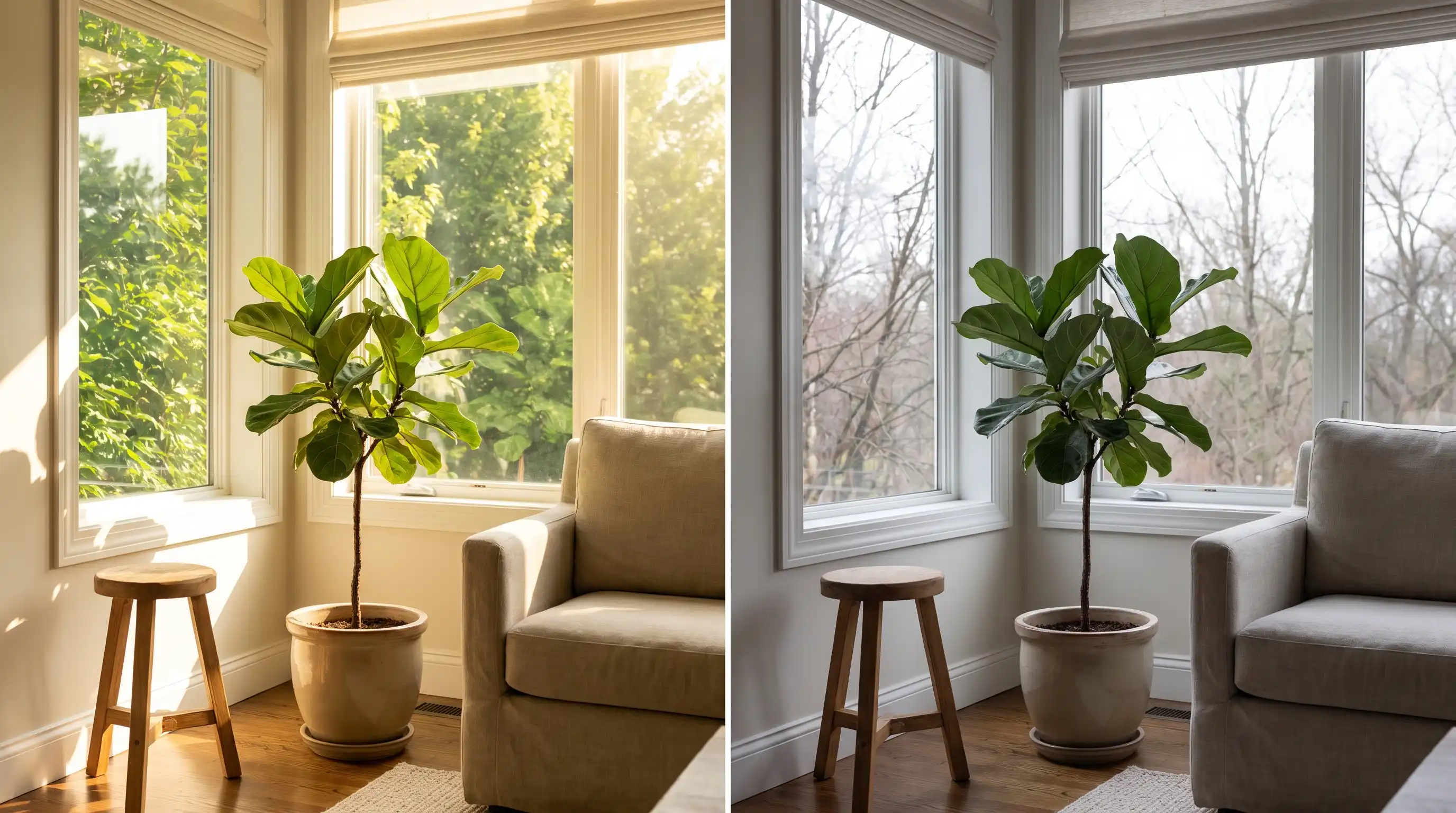
A window that delivers perfect bright indirect light in July may drop to low light by December.
In winter, the sun sits lower, days get shorter, and the angle shifts.
A plant that thrived all summer on an east windowsill can start to decline in November in that same spot, not because anything is wrong, but because the light changed.
What to do:
- Move plants 1 to 2 feet closer to windows in the fall.
- For the darkest months, use a grow light on a timer.
- In summer, watch south or west-facing plants for signs of direct afternoon sun.
- Rotate plants every two to three weeks for even exposure.
If your plant looks unhealthy in winter without any changes in care, it’s usually reacting to seasonal shifts.
Signs Your Plant Is Getting Too Much or Too Little Light
Your plant will tell you when the light is wrong. You just need to know what to look for, and the two problems show up in opposite ways.
When a plant is starved of light, it starts reaching. Watch for these:
- Stems grow long and lean toward the window (leggy growth)
- New leaves come in smaller and paler than older ones
- Variegated plants lose their patterns and go solid green
- Growth slows or stops entirely
Too much light does the reverse: instead of reaching, the plant gets scorched and dried out. The giveaways are:
- Leaf tips and edges turn brown or crispy
- Leaves look bleached or washed out
- Leaves curl inward or feel dry
- Soil dries out much faster than usual
Plants do not react overnight. It usually takes two to three weeks for stress to show visibly, so if you just moved a plant, give it time before assuming anything is wrong. If you move it again, give it the same patience.
Plants That Flourish in Bright Indirect Light
Most popular tropical houseplants sold in the US are built for bright indirect light, though a few are pickier about it than others.
The easygoing crowd barely needs instructions. Pothos and Philodendron will take a good deal less light than ideal and still look fine; they just grow faster and fuller the brighter you keep them (skip the direct afternoon sun on the Philodendron).
Peace Lily is nearly as forgiving and one of the few that genuinely tolerates medium light, though it flowers far better with more brightness.
Hoya sits here too, only slower: it creeps along in low light, but give it a bright spot, and it will actually reward you with growth.
A handful are fussier and worth placing deliberately:
- Fiddle Leaf Fig: The diva of the group. It wants consistent bright indirect light and no drafts, and it will drop leaves to punish you for either.
- Calathea — keep it to the softer end of bright indirect. Direct sun marks the leaves almost immediately.
- Bird of Paradise wants the brightest indirect light you can find, right up close to a south window.
- Monstera deliciosa needs the high end of the range to develop those signature leaf holes; too little light and the leaves stay solid.
Conclusion
Bright indirect light sounds technical until you test it with your hand and realize you already knew the feeling.
It is that spot near a window where the room feels wide open, but the sun is not hitting anything directly.
The shadow test takes 30 seconds. The window guide fits in a table. And now you know that the same spot can go from perfect to too dim by December.
Check your spots. Try the shadow test. If you are still unsure, a free light meter app on your phone gives you a real reading in seconds.
What window setup do you work with at home? Drop it in the comments, and we can help you figure out the best placement.
Frequently Asked Questions
1. how Do You Tell if a Room Has Bright Indirect Light?
A room has bright indirect light when it receives plenty of natural daylight, but the sun’s rays do not shine directly on the plant for extended periods.
2. Can Plants Get Too Much Bright Indirect Light?
Yes, some shade-loving plants can experience stress from excessive bright indirect light, which may cause fading, leaf discoloration, or slower growth.
3. What Indoor Plants Can Survive with Artificial Light?
Many indoor plants thrive under artificial light, including Pothos, Snake Plant, ZZ Plant, Peace Lily, Spider Plant, and Philodendron, especially when exposed to full-spectrum grow lights.