You checked that plant last week, and it looked fine. Great, even. Now the leaves are curling in on themselves, going yellow at the edges, and when you reach out to steady a stem, your fingers come away sticky.
Something is clearly wrong with your plant, but you can’t see a single thing causing it.
That’s the aphid special. They’re tiny, they’re excellent hiders, and they multiply like nobody’s business. Most of us don’t notice them until the damage is already done and the plant looks pretty rough.
But there’s one feature on every single aphid that makes them dead easy to identify once you know to look for it, and I’m going to show you exactly where it is.
What Do Aphids Look Like?
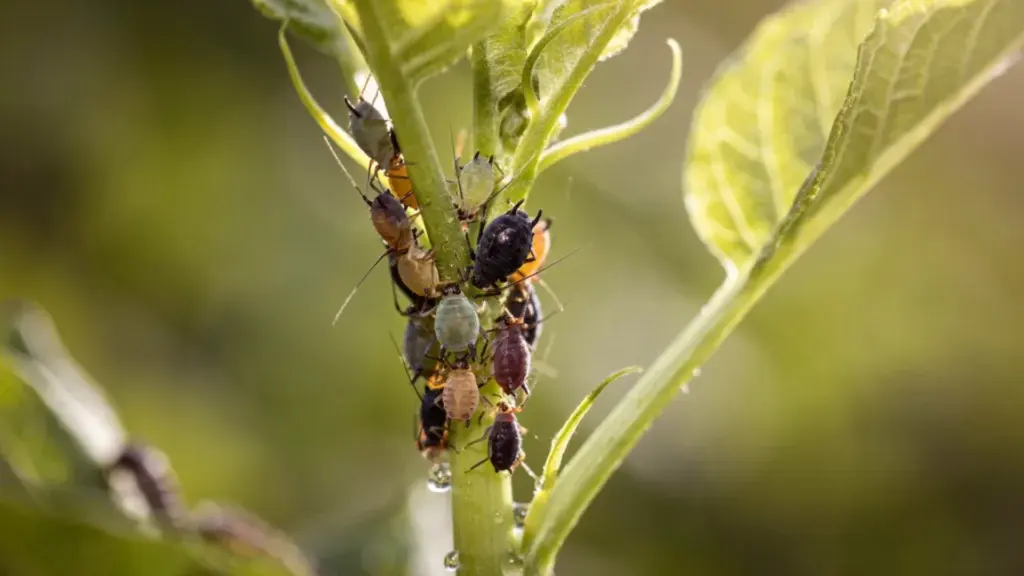
Aphids are small, soft-bodied insects, somewhere between 1/16 and 1/8 of an inch long. Think the head of a pin, and that’s your guy.
Their bodies are pear-shaped, a wide, rounded abdomen tapering up to a narrower head, with long antennae sticking out the front like they’re trying to pick up a radio station.
But here’s the part you actually need to memorize.
Look for the tail pipes
At the back end of the abdomen, an aphid has two small tube-like projections. These are called cornicles, and gardeners often call them “tail pipes” because that’s exactly what they look like sticking off the rear end of a very small, very slow car.
Every aphid has them. On some species, they are long and obvious, and on others they’re short enough that you’ll be squinting at your plant.
But they are always there, and no other common garden insect has them. If you find the tail pipes, you have found aphids, case closed.
Most aphids you’ll encounter on your plants don’t have wings. The adults are usually wingless, quite content to sit there and eat your plant. But when a colony gets crowded, or the plant starts running low on nutrients, some of them will grow wings so they can fly off and start a brand new colony somewhere else. (On your other plants, because of course.)
Young aphids are called nymphs, and they look just like the adults, only smaller. They go through several growth stages and shed their outer skin each time.
You’ll often find those tiny white cast-off skins stuck to your leaves or floating in the sticky residue below. I’ll admit, the shed skins are sometimes what tips me off before I ever spot an actual insect.
Aphid Colors: Why They Are Not Always Green
Ask most people what an aphid looks like, and they’ll say a tiny green bug. Some of them are! Plenty are not, and that’s how so many infestations sail right past us.
Color depends entirely on the species and on what the aphid is eating. They come in green, black, red, yellow, brown, and gray. Some wear a waxy white coating that makes them look powdery, almost dusted.
Others are wrapped in waxy threads that give them a fluffy, cotton-ball look, and those are woolly aphids, which don’t look like insects at all at first glance.
Here’s a quick reference for the ones you’re most likely to meet in your garden:
Color/Appearance | Common Name | Plants They Target |
|---|---|---|
Yellow-green | Green peach aphid | Vegetables, flowers |
Gray-white, waxy | Cabbage aphid | Cabbage, broccoli, kale |
Cottony white | Woolly apple aphid | Apple and pear trees |
Black | Black bean aphid | Beans, beets, dahlias |
Pink or reddish | Rosy apple aphid | Apple and pear trees |
Winged aphids tend to be a bit darker than their wingless relatives of the same species. So if you spot a dark little winged thing creeping slowly along one of your stems, don’t write it off. Check the back end for tail pipes first.
Where to Find Aphids on Your Plant
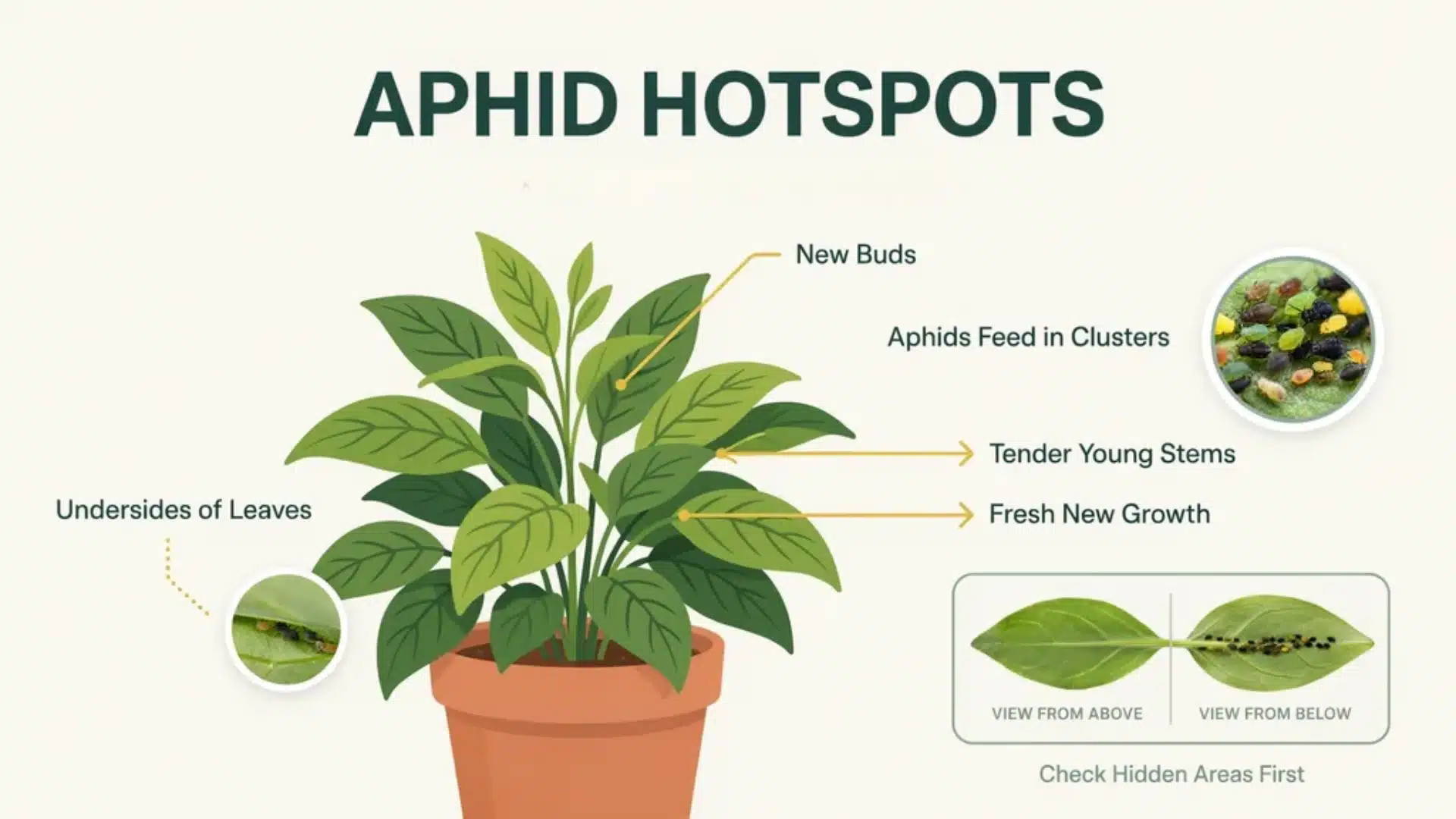
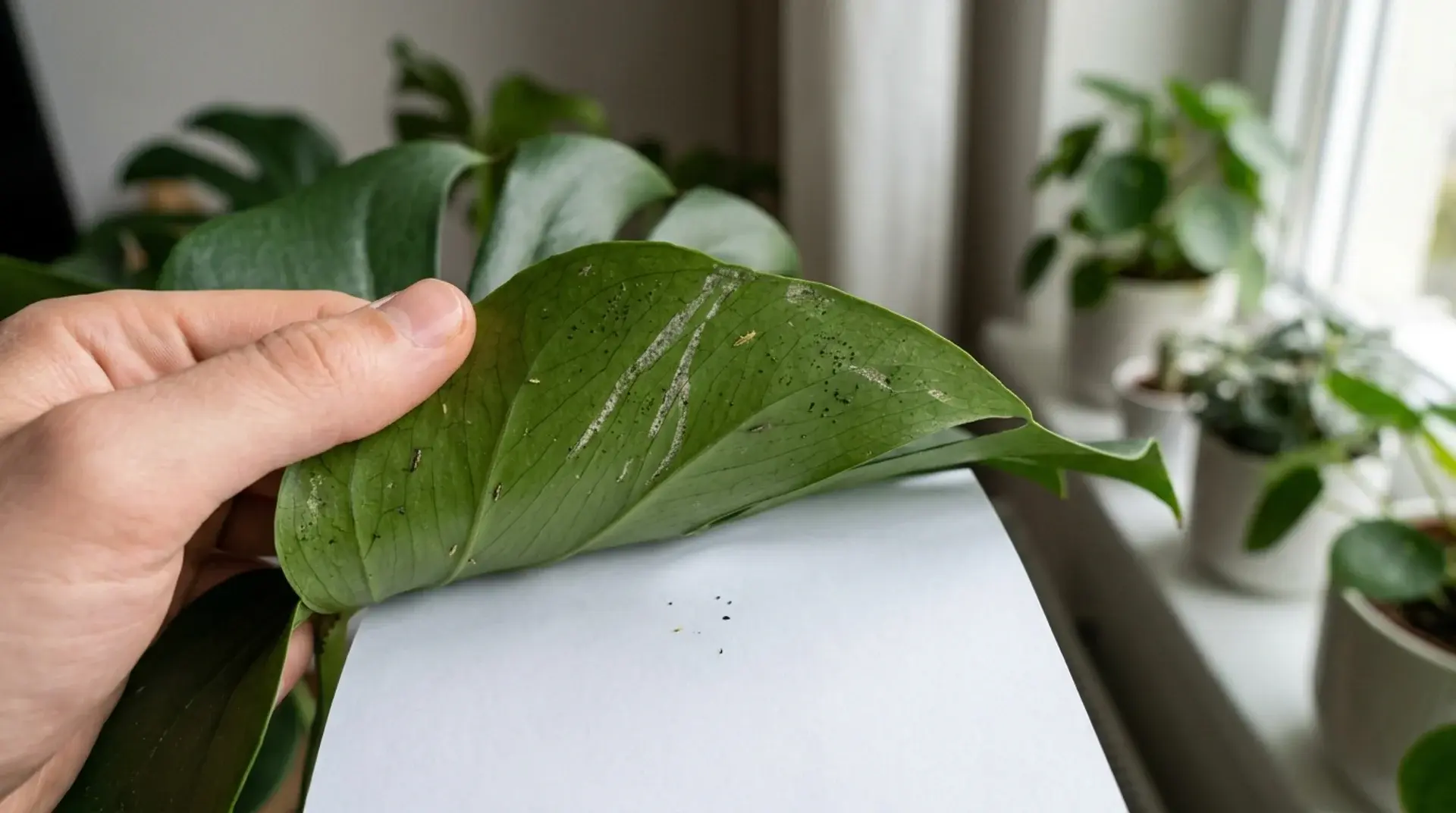
Flip your leaves over. That’s step one, and it’s the step most gardeners skip.
Aphids adore the undersides of leaves, tucked away from the light and out of your line of sight. They also crowd around new buds, soft young stems, and the freshest leaves on the plant. Tender growth is really the good stuff as far as they’re concerned.
And they almost never travel alone, so you will rarely find one aphid sitting by itself. Look instead for clusters of dozens of small, soft bodies packed shoulder to shoulder on a stem or lined up along a leaf vein like commuters.
This is exactly why aphids on houseplants go unnoticed for weeks. You glance down at the tops of the leaves on your way past, everything looks fine, and the whole party is happening underneath.
How to Tell Aphids Apart From Similar Insects
Okay, so you’ve found little bugs on your plant. Now let’s make sure they are the right little bugs.
Aphids vs. whiteflies: Touch the plant and see what happens. If a tiny white cloud lifts off and swirls around, those are whiteflies, because aphids barely react when you disturb them. That test alone usually settles it.
Aphids vs. mealybugs: Mealybugs are coated in a thick, waxy white fuzz all over. Aphids can look waxy too, but aphids have the cornicles at the back end and mealybugs do not.
Aphids vs. spider mites: Mites are round and leave fine webbing strung between your leaves. Aphids leave sticky honeydew and those little white shed skins, but no webs.
Adults vs. nymphs: Same bug, different size. If you’re finding big ones and small ones together on the same plant, that’s one colony growing up.
Thrips vs. aphids: Thrips on plants leave silvery streaks on leaves instead of sticky honeydew, and they’re much thinner and more elongated than aphids.
What to Do Once You Spot Aphids
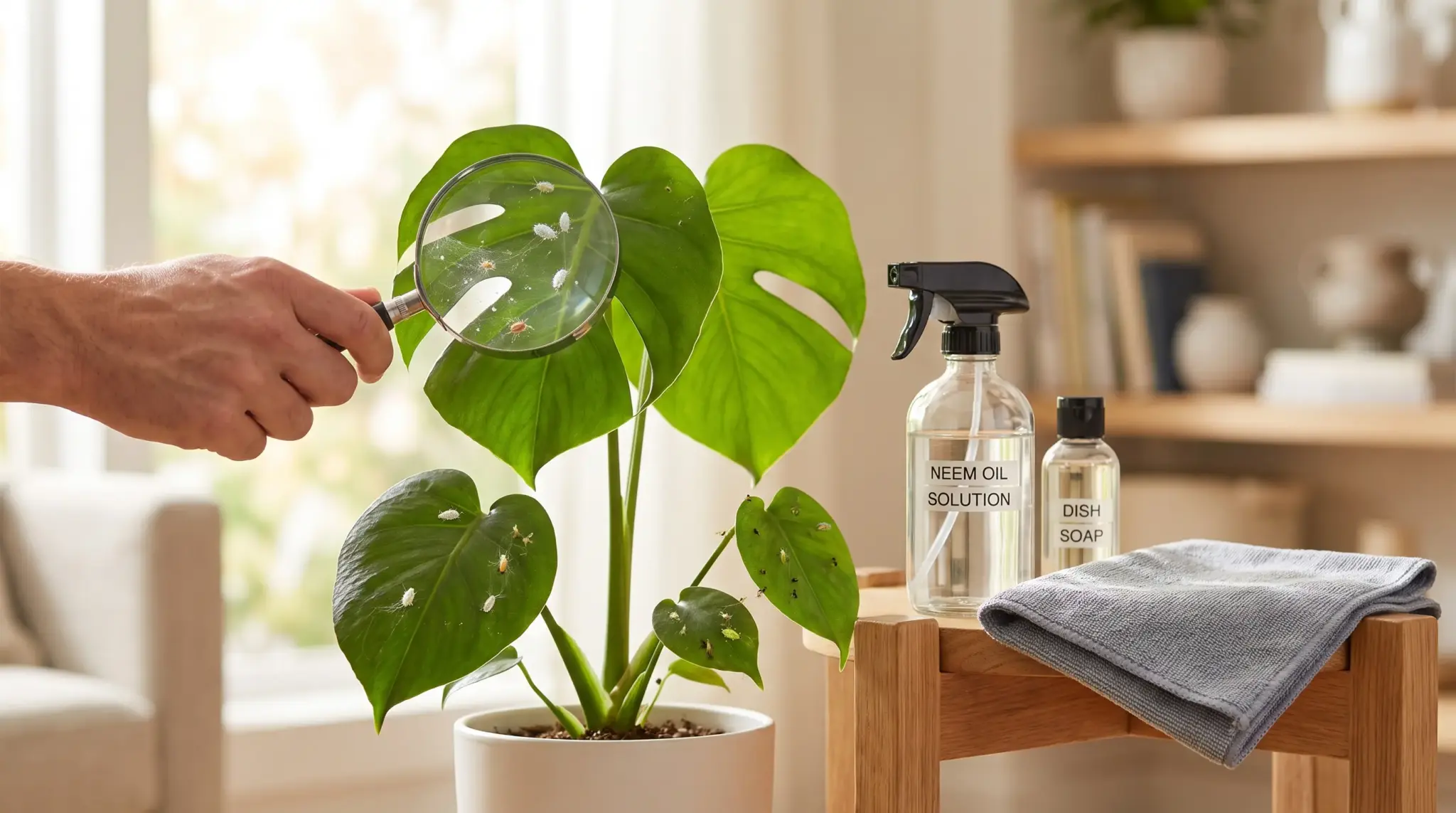
Blast them off with water first. A strong stream from the hose, or a good spray bottle for your houseplants, knocks them clean off, and they rarely manage to climb back up.
If that isn’t enough, insecticidal soap kills them on contact without leaving harsh residue behind. Spray the undersides of your leaves, not just the tops. Please. The tops are not where they live.
Neem oil is the slower option. It won’t drop them on the spot, but it stops them feeding, and as it moves through the plant’s system, the colony dies off.
I compared neem oil and insecticidal soap side by side to figure out which one I’d reach for first, and the answer depends on how bad things have gotten.
And if you see ladybugs, lacewings, or parasitic wasps hanging around your plants (especially their weird-looking larvae), leave them right where they are. They’re on the payroll.
Catch Them Early, and It’s Barely a Problem
Pear-shaped body, two tail pipes at the back, clustered under your leaves and on the newest growth. That’s the whole identification, and it takes about four seconds once you know it.
Pair that with the early warning signs of sticky leaves, curling foliage, and tiny white shed skins, and you’ll catch them while it’s still a small, boring problem instead of a weekend of spraying.
Got ants marching up a stem right now? Go flip a leaf over and tell me in the comments what you found.
Frequently Asked Questions
What Kills Aphids Instantly?
Soapy water does quite a number on them, but a good strong jet of water is faster and dislodges or squashes most of the colony on the spot.
What Month Do Aphids Come Out?
In spring. The eggs hatch and the new aphids go straight for the young foliage, which is why your tenderest new growth gets hit first.
What’s the Best Homemade Aphid Spray?
Mix a few tablespoons of a pure liquid soap, something like Castile, into a small bucket of water, and that’s really all there is to it. Spray the undersides.