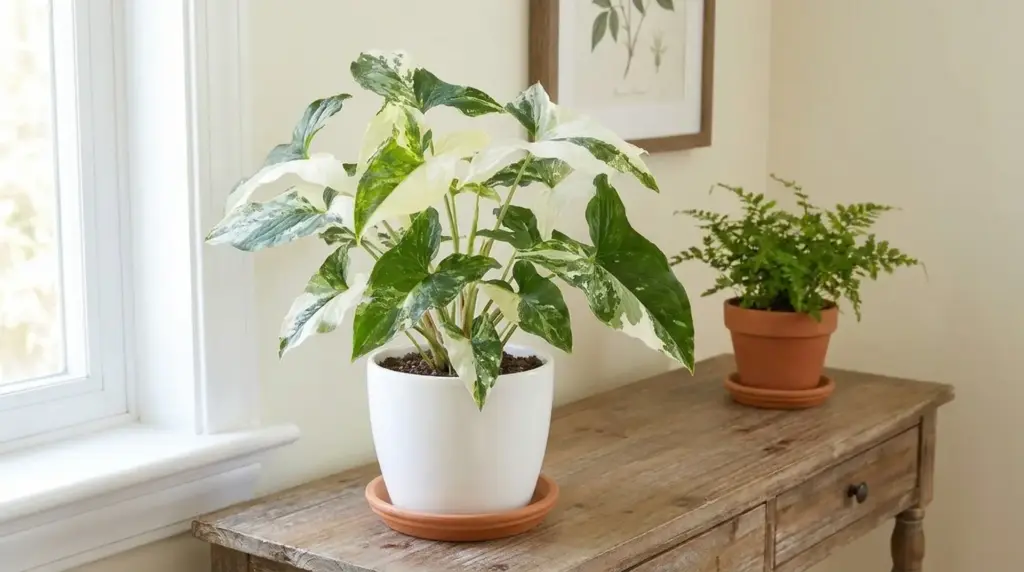
Albo syngonium (Syngonium podophyllum albo-variegatum) has certainly been having a moment. It’s become a favorite among plant collectors for its striking variegated leaves, and we can see why it’s so well loved.
No two leaves are alike, and each seems more beautiful than the last!
Albo syngonium is the variegated form of the more common Syngonium podophyllum, which you’ve no doubt seen in shades of pink and green.
Its care is nearly identical to its non-variegated counterpart, so it’s a relatively easy plant to look after. It doesn’t need dedicated or specialized care, and it grows steadily with little attention.
Here’s everything you need to know to keep yours looking its best.
Albo Syngonium Care Tips
Albo syngonium needs the right balance of light, water, and humidity to maintain its striking white variegation while supporting healthy leaf growth.
1. Light Requirements
To maintain its variegated color, albo syngonium should be grown in bright indirect light. If it’s grown in medium indirect light, your plant may produce more green leaves.
Direct sun can scorch the leaves, and the white sections are the most delicate, so keep it a step back from a sunny window. The white areas can’t make food for the plant, which is why the green parts need steady, gentle light to do the work.
2. Watering Tips
Allow about two-thirds of the soil to go dry in between waterings. In a 6-inch pot, that’s roughly the top 3 to 4 inches, and a finger pushed into the soil is the easiest way to check.
Drooping stems are the plant’s way of asking for a drink, so water when you see them and don’t leave the pot sitting in water. Dry, crispy leaf tips and slowing growth can mean it has gone too long between drinks, so a regular check keeps you ahead of it.
3. Soil, Feeding, and Humidity
Albo syngonium does best in a well-draining potting mix that holds a little moisture without turning soggy. Feed it once a month in spring and summer with a houseplant fertilizer diluted to half strength, then ease off in winter when growth slows.
Average room humidity is fine, and temperatures between 70°F and 80°F keep it comfortable. It’s one of the friendlier picks if you’re building a collection of easy houseplants.
How to Propagate Albo Syngonium
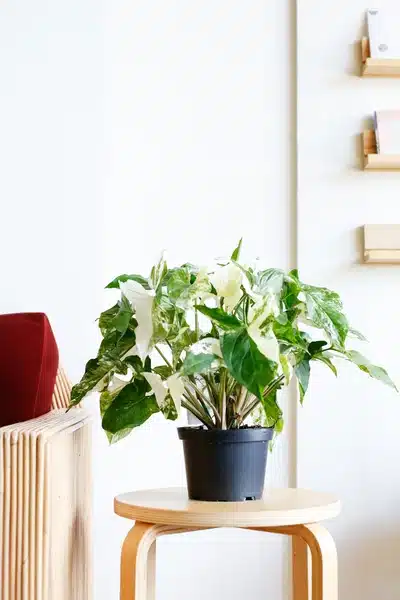
Albo syngonium grows fast, and trimming leggy vines back to just above a node keeps it bushy. Albo syngonium also roots easily from stem cuttings, so every trim doubles as a way to get a new plant.
Trim leggy vines: Cut stems just above a node to encourage bushier growth and remove yellow or tired leaves to keep the plant looking healthy.
Choose healthy cuttings: Take stem cuttings with at least one node and a healthy leaf showing both green and white variegation. Avoid fully white leaves.
Make the cut: Cut just below a node (the small bump where a leaf joins the stem).
Root the cutting: Place it in a jar of water with the leaves above the waterline, or plant it in moist, well-draining soil with the node about an inch below the surface.
Provide the right conditions: Keep the cutting in bright indirect light and allow time for roots and new growth to develop.
Pot up rooted cuttings: Once water-rooted cuttings develop a healthy set of roots, transfer them to a suitable potting mix.
Propagate during the growing season: Spring and summer are ideal, giving new cuttings enough time to establish before fall.
Is Albo Syngonium Toxic to Cats and Dogs?
Yes. The ASPCA toxic plant list names arrowhead vine (Syngonium podophyllum) as toxic to cats and dogs because it contains insoluble calcium oxalates.
Chewing it can cause oral irritation, pain and swelling of the mouth, tongue, and lips, excessive drooling, vomiting, and difficulty swallowing.
A high shelf or hanging planter keeps it out of reach.
Important Note: If your pet does chew on it, call your vet or ASPCA Animal Poison Control at (888) 426-4435 (a consultation fee may apply). |
|---|
A plant this easygoing is easy to love. Give it a bright spot and a moss pole, and each new leaf comes in with a pattern all its own. It’s a plant that gets more interesting the longer you keep it.
Frequently Asked Questions
Which is the rarest Syngonium?
There is no single “rarest” Syngonium, because availability changes as tissue culture and plant propagation make once-rare collector varieties more common. However, several Syngonium cultivars are consistently considered the hardest to find.
What is the most beautiful Syngonium?
There is no single “most beautiful” Syngonium because beauty depends on whether you prefer high-contrast variegation, moody bronze tones, or soft pastels.
How long does Syngonium live?
A Syngonium (commonly known as an arrowhead plant or arrowhead vine) is a perennial plant that can live for 10 to 15 years or more with proper care.