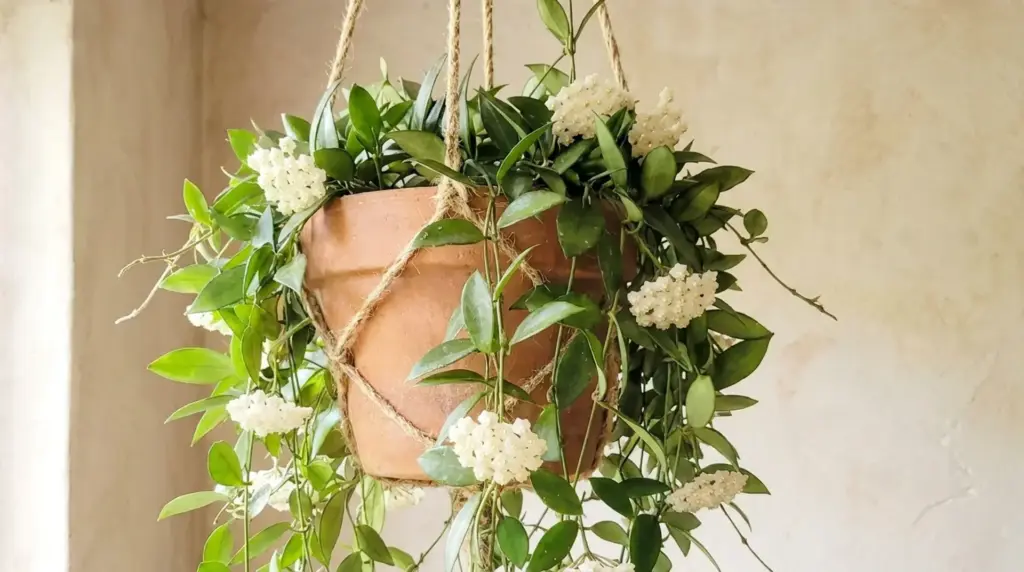
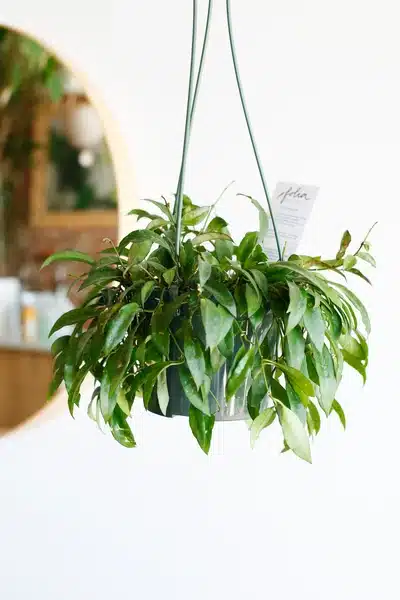
This is Hoya lacunosa, a cinnamon-scented Hoya that earns a spot in any Hoya lover’s home. It’s a little quirky, too.
Most Hoya are known for thick, succulent-like leaves, but the leaves of Hoya lacunosa stay small and are much thinner than many of its relatives.
Its growth habit is different as well. Many Hoya are climbers and will readily attach their vines to anything they touch.
Hoya lacunosa mostly trails, much like other indoor hanging plants, so you won’t need to worry about it marching up the nearby furniture. If you want it to climb, a small trellis gives it something to hold on to.
Because of these differences, it needs some care you may not be used to with other Hoyas. We’ve got all of the care info you’ll need right here.
How to Care for Hoya Lacunosa
Keeping Hoya lacunosa healthy and encouraging it to bloom comes down to getting a few basic care conditions right, from lighting and watering to soil, temperature, and humidity.
1. Light Requirements
Hoya lacunosa will grow best in bright indirect light. It may be grown in medium indirect light, but it may never flower. Direct sun can scorch the leaves, and too little light leaves the plant weak and leggy.
2. Watering Tips for Hoya Lacunosa
Your Hoya lacunosa should be allowed to go almost completely dry in between waterings, but don’t let it sit dry for too long. Its small, thin leaves hold less water than the thick leaves of many other Hoyas, so it handles long dry spells poorly.
Water less often in winter, when growth slows. Pushing a finger into the second knuckle is an easy way to check (the same test works when watering houseplants).
3. The Best Soil for Hoya Lacunosa
Your Hoya Lacunosa will grow best in a chunky, well-draining soil mix. Mixing orchid bark and perlite into regular potting soil gives the roots the airy texture they like.
Pick a pot with drainage holes, or a hanging basket with plenty of airflow around the roots.
4. Temperature, Humidity and Feeding
Hoya lacunosa likes warmth, between 68 and 77°F, with humidity around 50 to 70%. It’s hardy only in USDA zones 10b to 12b, so outside those zones it lives indoors year-round.
Feed once a month at half strength during the growing season, and ease off in winter.
Hoya Lacunosa Flowers and Popular Varieties
Each cluster lasts only about five days, so enjoy them while they’re open. If yours isn’t blooming, move it somewhere brighter and check that the old flower stalks are still on the plant.
Popular Hoya Lacunosa Varieties:
Several named forms of Hoya lacunosa are sold. The care above fits all of them, though variegated forms like a bit more light.
Hoya Lacunosa Variety | Description |
|---|---|
Mint | Opens pale green and ages to a silvery mint. |
Silver | Has silver and green variegated leaves and pink flowers. |
Splash | Compact and trailing, with deep green leaves flecked in silver and creamy, fuzzy flowers. |
Eskimo | Has heart-shaped green leaves and fluffy white flowers. |
Royal Flush | Has dark green leaves edged in red and pink blooms. |
Snowcaps | Has dark green leaves speckled with white and white flowers. |
Black Queen | Has dark green leaves with black edges and white flowers. |
How to Propagate Hoya Lacunosa
Hoya lacunosa roots from stem cuttings. We take a cutting just below a node (the bump where a leaf meets the stem) and strip the lowest leaf.
The stems have rooting nodes along them, so cuttings do well in water, soil, or perlite. Wait until the roots are an inch or two long before potting up a water cutting.
Common Hoya Lacunosa Problems
Mealybugs and spider mites are the pests to watch for. Check where the leaves meet the stems, since bugs on indoor plants are much easier to clear when we catch them early.
Overwatering is the other usual trouble, because a pot that stays wet leads to root rot.
A plant this small shouldn’t smell this good, but Hoya lacunosa manages it anyway. Give it bright light and a pot that drains well, and leave the old flower stalks alone.
It’s a quirky little plant, and among the easy houseplants, it’s worth the windowsill space.
Frequently Asked Questions
Is Hoya lacunosa Pet Safe?
NC State Extension lists Hoya lacunosa as non-toxic to cats and dogs. The ASPCA lists the related wax plant, Hoya carnosa, as non-toxic to both. The milky sap can irritate skin, so wear gloves when pruning.
Why is a Hoya plant so expensive?
Rare or specialty Hoya plants can be expensive due to a combination of slow growth rates, limited supply, high collector demand, and the intensive care required to cultivate unique varieties.
How fast does Hoya lacunosa grow?
Hoya lacunosa is generally considered a moderate-to-fast grower compared to many other slower-growing Hoya species. In optimal conditions, a healthy plant can grow around 40 centimeters of new vine length within a few months.
Are Hoya krohniana and lacunosa the same?
Hoya krohniana and Hoya lacunosa are closely related, and whether they are the same species is a long-standing debate among botanists and plant collectors.